
Every Invoice Looked Fine. Together, They Told a Different Story.
Read the story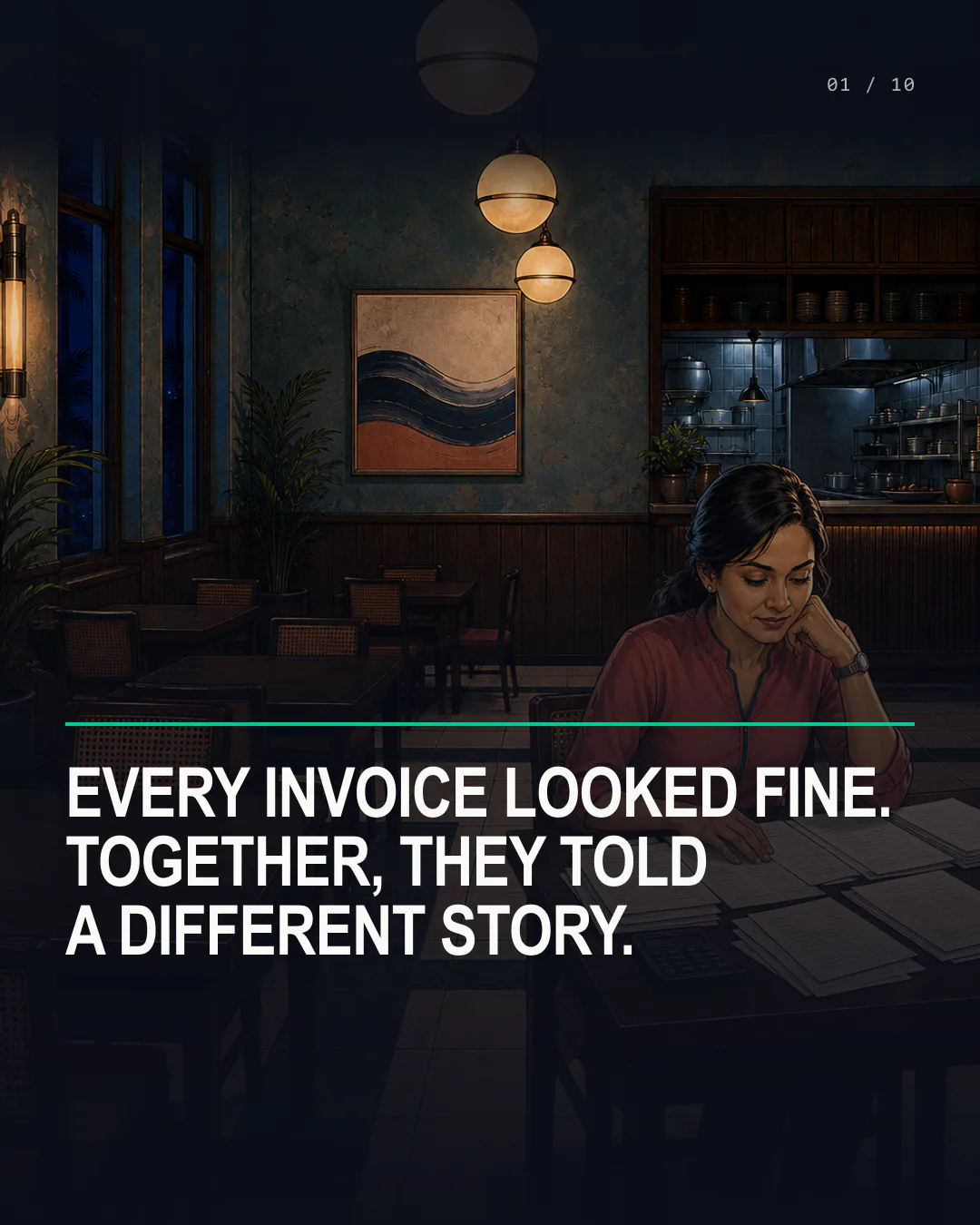
At 3:04 a.m., Meera sat at a table in Coastal House beneath one lamp. A calculator waited beside a stack of supplier invoices. Her phone lay face down. She entered a number, cleared it, and entered it again.
The number was not obviously wrong. That was what kept her awake.
Coastal House had closed hours ago. Forty chairs were empty, the kitchen pass was quiet, and the last delivery docket had been pushed onto its spike. Meera could remember the evening table by table: who had waited for a second neer dosa, which dish came back too salty, and where a server had lost three minutes.
She knew the restaurant in that intimate way. She could look across a full room and spot the one table still waiting. She could taste a curry and name what it needed. She could move a garnish by two centimetres and send the plate out without looking twice.
So why did the arithmetic refuse to settle?
Every invoice looked fine
The invoices on Meera’s table were ordinary. Produce. Cooking oil. Dry goods. Familiar quantities from familiar suppliers.
None announced itself as the problem.
On most delivery days, Meera met the clipboard at the back door while service was beginning. She checked the delivery, signed the sheet, and turned back towards the kitchen. Each total looked close enough to the previous one. Each change had an explanation: seasonality, availability, one ingredient priced differently that week.
Seen one at a time, the invoices gave her no reason to stop.
Seen together, they told a different story.
In this scenario, food cost had moved from 29% to 34% of revenue across four months. The movement was not hidden in one spectacular mistake. It had accumulated through a sequence of ordinary-looking entries.
Five percentage points look clear when they are drawn as a line. They are much harder to feel while a restaurant is full, the pass bell is ringing, and the evidence arrives one invoice at a time.
Meera had not failed to care. She had not forgotten how to run her restaurant. She had been asked to notice a pattern before anyone had assembled it.
Back at the table, she sorted the pages by date. The individual totals had not become any more dramatic. The order had changed what she could see. A delivery that had seemed unremarkable during service now sat beside the deliveries before and after it. The question was no longer whether this invoice looked right. It was whether the familiar sequence was moving in an unfamiliar direction.
The problem had a name: the lag
There is a particular kind of uncertainty that follows a growing business owner home. It begins when something feels different before the accounts can show what changed.
Sales may still look busy from the floor. Suppliers may still look familiar on paper. The owner senses movement, but the explanation lives across records that are still being brought up to date.
That distance is the lag: the time between what is happening in the business and when the books make it visible.
The lag turns a specific question into a general worry. Instead of asking, “Which purchase entries moved this cost line?”, the owner asks, “Why does the month feel tighter?” Then the calculator comes out at 3:04 a.m.
The issue is not that month-end accounts have no value. They do. The issue is timing. A clear answer that arrives after weeks of repetition can explain the past without helping the owner examine the pattern while it is still forming.
Meera did not need a louder warning. She needed the books to be current enough for the warning to arrive early.
A line she could follow
GeniusCFO is built around that operating condition: books that stay current instead of waiting for a later catch-up.
In Meera’s GeniusCFO screen, an alert states that food cost has moved from 29% to 34%. It identifies the movement and links it to the posted purchase entries behind the change.
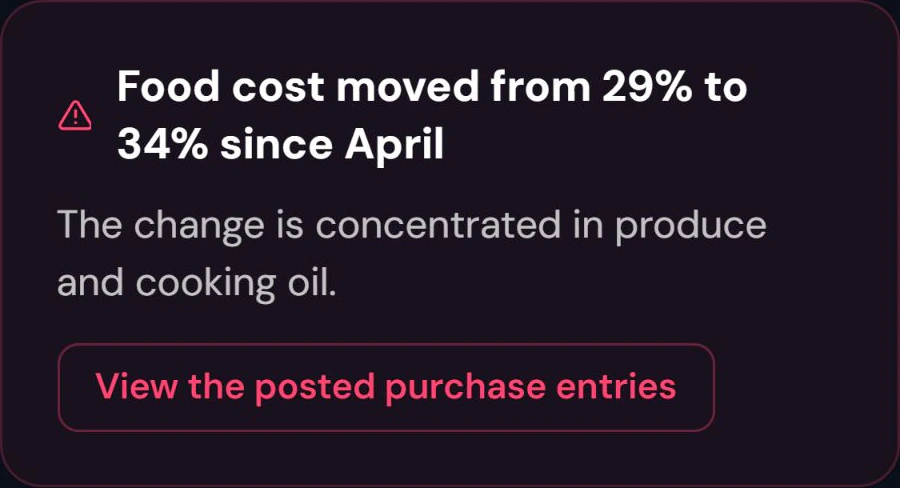
That trace matters.
An unexplained percentage is another number to carry. A percentage connected to booked records gives the owner somewhere to begin. Meera can review the entries, isolate the relevant invoices, and ask what changed. The alert does not decide whether a price is fair, whether a quantity was necessary, or what she should do next. It turns an unnamed concern into a reviewable question.
The distinction is important because financial software should not pretend that a notification is judgement. The work can be prepared and the evidence can be surfaced, while professional review and sign-off stay with the Chartered Accountant.
The work is automated. The judgement stays human.
The next morning, one specific question
Meera did not storm into the kitchen or accuse a supplier. She printed the relevant entries, placed them beside the invoices, and returned to the back door the next morning.
“Help me understand this line,” she said.
That is the outcome of this story. Not a guaranteed saving. Not a promised increase in profit. Not software making a commercial decision on her behalf.
Meera now had a specific question and the evidence behind it. The supplier could explain the change. Meera could check the operational context. Her Chartered Accountant could retain review and sign-off. The people responsible for the decision still made it.
What changed was when the conversation could begin.
At 3:04 a.m. the following night, a ceiling-fan shadow crossed her bedroom wall. Meera’s eyes were closed. The restaurant had not become predictable, and no product can promise that it will. But the question that had followed her home was no longer shapeless.
It had a line. It had entries. It had people who could review both.
Dramatised, illustrative scenario: Meera, Coastal House, its suppliers, and every financial figure in this advertorial are fictional. They are used to explain a business pattern, not to report a customer result.