
Nobody Warned You the Business Came With a Second Job.
It starts around three in the morning, it is unpaid, and the numbers you do it with are weeks old.
Read the story
It is 3:04 a.m. and you are counting on your fingers in the dark. Not because you are bad at this. Because a supplier payment, a GST payment and payday have landed in the same week, one customer has not paid, and the only place those four facts sit together is your head.
You count. You stop. You start again from one, because the thread went somewhere between the second number and the third.
Nobody warned you about this job.
The job nobody hires for
A business large enough to feel this hires someone for it. The job has a title, a salary and a chair. A business still growing into that size cannot justify the salary yet, so it goes to the one person who cannot hand it to anybody else. You do it alone, at the worst hour of the day, using records that are still catching up.

You are not doing it badly. You are doing a specialist's job in the dark with weeks-old information, because that is the only form in which it reaches you.
Forty-five machines, forty-five people
Take a dramatised case. Harpreet Singh runs a garment unit: forty-five machines, forty-five people. Payday is the 7th, circled on the office calendar in red pen, more than once. This month a supplier payment and a GST payment fall in the same week as payday, and a customer invoice has not cleared.

Every one of those dates was correct. Every one was knowable weeks earlier. They had never once been in the same place at the same time — except in Harpreet's head, at 3:04 in the morning.
The lag: why the answer arrives late
That distance has a name.
The lag: the time between something happening in your business and the books being able to show it.
The lag does not make the answer wrong. It makes the answer late. And a late answer turns a specific question — which payments collide, and when — into a general worry that follows you up the stairs and sits with you until four.

Month-end accounts are not the problem. They are accurate, and they are worth having. The issue is timing: an answer that arrives after the week has passed can explain a collision without leaving anyone room to move it.
Eighteen days is not a rescue
GeniusCFO takes that job.
Because the books are kept current every day rather than caught up at month-end, the collision surfaces while there is still room to move. In this illustrative scenario the Intelligence Hub flags a cash gap eighteen days out: ₹6,40,000 of supplier payment and GST landing before a customer invoice clears, with the posted entries behind it attached to the alert.

Eighteen days is not a rescue. It is a week and a half of options. Harpreet made one phone call and moved one payment date by two days.
On the 7th, nothing happened
Forty-five envelopes went across a table into forty-five pairs of hands, and nobody in the unit knew there had been a question.
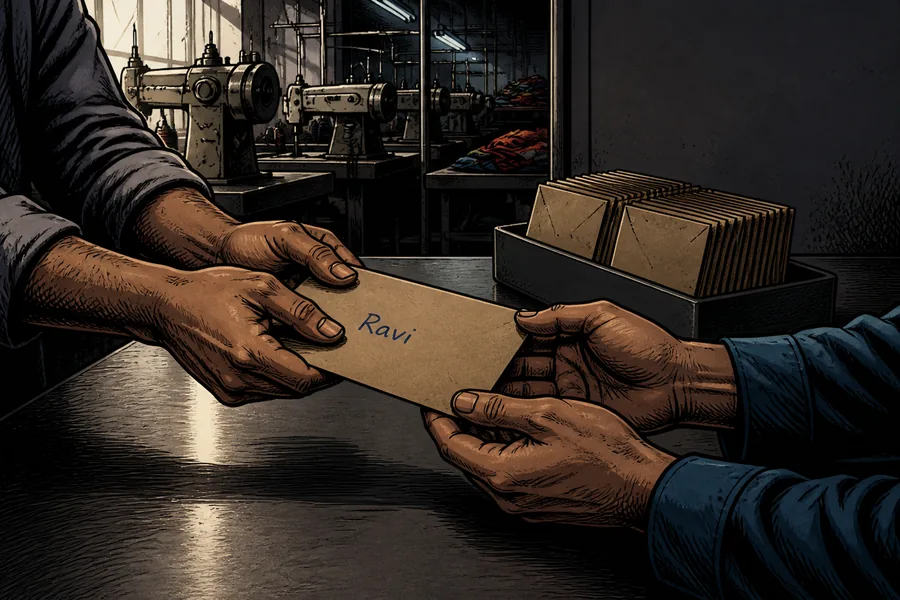
The alert decided none of that. It did not judge whether a supplier's terms were fair or whether a payment could wait. It turned an unnamed worry into a reviewable question with the entries underneath it.
Professional review and sign-off stay with your Chartered Accountant.
The work is automated. The judgement stays human.
The second job does not disappear. No software can promise a business that never surprises you. What changes is the hour at which you find out, and whether you are counting on your fingers or reading a line that has already been counted.
At 3:04 the following month, the fan shadow crossed the ceiling as usual. Harpreet was asleep.
Questions this story raises
What is a cash gap?
A cash gap is a stretch where money leaving the business — a supplier payment, a GST payment, payday — falls due before money owed to the business arrives. The dates are usually known weeks earlier. They are rarely written down in one place.
How does GeniusCFO warn about a cash gap early?
Because the books are kept current every day rather than caught up at month-end, the Intelligence Hub can flag a collision while there is still room to move, and attach the posted entries behind it so the figure can be reviewed rather than taken on trust.
Does GeniusCFO replace my Chartered Accountant?
No. GeniusCFO prepares the work: entries booked with debits and credits, the bank reconciled, GST information prepared and Schedule III statements produced. Professional review, judgement and sign-off stay with your Chartered Accountant.
Fifteen minutes, one to one.
Dramatised, illustrative scenario: Harpreet Singh, his unit, its suppliers and every financial figure in this advertorial are fictional. They are used to explain a business pattern, not to report a customer result.